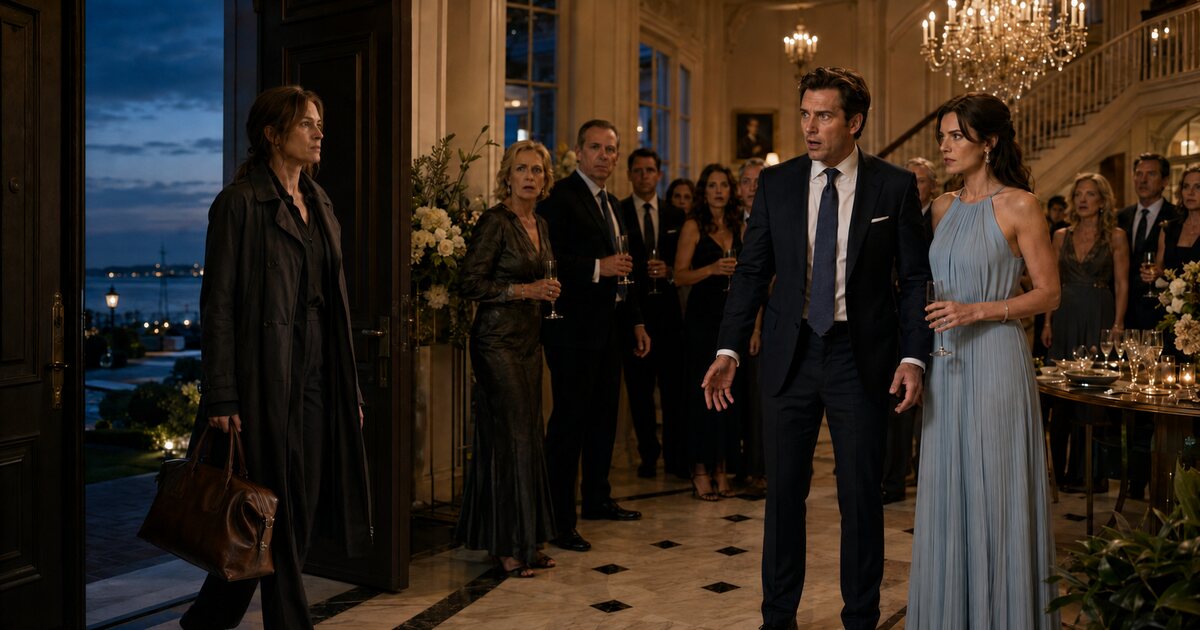
I learned that I had been dead for eleven months when United States Customs confiscated my passport.
The officer looked at his screen, looked at me, and asked me to place both hands flat on the counter.
“According to federal records, Lydia Carr died in a house fire last August.”
I had just spent fourteen months helping rebuild an Antarctic research station. I had not seen my family, followed local news, or used social media during that time.
While I was gone, my brother buried a woman under my name, inherited our father’s thirty-one-million-dollar estate, and scheduled his engagement party in the house we were supposed to share.
He expected nearly two hundred guests that evening.
He did not expect the dead woman to walk through the front door.
Customs kept me for three hours.
They took my fingerprints, contacted my employer, compared an old passport photograph with my face, and eventually accepted the obvious conclusion.
I was alive.
The government’s records, however, said otherwise.
My first call was to Helen Park, the attorney who had handled my father’s affairs for twenty years.
She answered cheerfully.
When I said my name, she stopped speaking.
“Helen?”
“Where are you calling from?”
“Baltimore-Washington International Airport.”
A chair scraped against the floor on her end.
“Lydia, this is not funny.”
“I’m not laughing.”
She asked me three questions only the real Lydia Carr could answer. The name of her first dog. The amount my father had paid her after losing a bet. The location of the scar on my left hand.
Then she began to cry.
“My God,” she whispered. “We buried you.”
Helen met me at the airport carrying a legal file. She was still holding it when she hugged me. Then she stepped back and studied my face as if she needed to confirm it twice.
The fire had occurred at our family’s cottage near Chesapeake Bay. A woman’s body had been found inside my bedroom. The remains were badly burned, but investigators had recovered my necklace, my watch, and a dental chart bearing my name.
Owen had identified the jewelry.
He had also supplied the dental records.
My death certificate was issued six days later.
Our father died of pancreatic cancer four months after my funeral.
I stared at Helen.
“My father is dead?”
She nodded.
I had sent Owen an email every month from Antarctica. He had replied that Dad was responding to treatment and did not want me abandoning my contract.
The final message from my brother had arrived just three weeks earlier.
Dad is sleeping more, but he’s stable. Finish your work. He’s proud of you.
My father had already been buried for six months.
Helen opened the estate file.
His will divided everything equally between Owen and me. If either child died first, the surviving child inherited the entire estate.
Owen had received the waterfront house, controlling shares in Carr Maritime, the investment accounts, and every remaining family property.
“He told everyone you had secretly returned from Antarctica,” Helen said. “He said you were staying at the cottage because you didn’t want anyone to know you had broken your contract.”
“And nobody called my employer?”
“Your brother provided emails supposedly written by you.”
I already knew what those messages would say.
I had given Owen access to my personal email account before leaving because the research station’s connection frequently rejected password-verification messages. He had promised to forward anything important.
Instead, he had used the account to construct the final months of my life.
Helen filed an emergency petition to restore my legal identity and freeze the estate. Then she showed me the engagement announcement.
Owen Carr and Camille Arden request the pleasure of your company.
The party began in less than two hours at my father’s house.
“You should go somewhere private,” Helen said. “Let the court handle this.”
I looked at the photograph beneath the announcement. Owen and Camille stood on the terrace overlooking the bay. He wore my father’s watch. She wore a pale blue dress and held her left hand toward the camera.
Behind them was the house where I had grown up.
“No,” I said. “I have been private for eleven months.”
We stopped at the cemetery first.
My grave sat beneath a maple tree beside my mother’s. The stone bore my full name, my birth date, and a death date from the previous August.
Beloved daughter and sister.
Owen had chosen the inscription.
Someone had placed fresh white roses beneath it.
I looked down at the soil and tried to understand that a woman was lying there with my name carved above her.
Helen touched my arm.
“We can request an exhumation immediately.”
“I want to know who she was.”
“We will.”
“No. I want Owen to tell me.”
The Carr house glowed above the water when we arrived. Valets moved luxury cars along the circular drive while a string quartet played beneath the terrace windows.
Helen parked near the gate.
“You are about to enter a crowded room containing a man who may have committed several felonies to make the world believe you were dead.”
“He also stole my half of thirty-one million dollars.”
“That is included in the several felonies.”
We walked to the front entrance.
A young man checking invitations smiled at Helen, then looked at me. His face emptied.
He had worked for my father for nine years.
“Ms. Carr?”
“Apparently.”
He stepped away from the door without asking for an invitation.
The first person to see me inside dropped a champagne glass.
The second screamed.
The room went quiet from the doorway outward as people turned to look. Some stared. Some reached for their phones. One elderly cousin crossed herself even though she had spent most of her life telling everyone she was an atheist.
Owen stood beneath the main staircase with Camille.
His engagement toast was still in his hand.
He looked exactly as he had when I left, except for the expensive suit and my father’s gold watch.
The glass slipped from his fingers and struck the floor.
“Hello, Owen.”
He backed into the staircase railing.
“No.”
I walked across the foyer while guests moved away from me.
Camille did not move.
She watched my face with an intensity that felt different from everyone else’s shock. There was recognition in it, but not surprise.
Owen found his voice.
“Whoever you are, this is a private event.”
“I’m Lydia.”
“My sister is dead.”
“Your sister just spent three hours proving otherwise to Customs.”
I placed my passport on the table beside him.
He did not touch it.
“This woman is an impostor,” he announced. “Someone call security.”
“I already called law enforcement,” Helen said.
She opened her folder and removed copies of the emergency court filing, my verified fingerprints, and the notice freezing every asset distributed through the estate.
Owen read the first page.
His face changed again when he reached the account numbers.
“You froze the company?”
“The court did,” Helen replied. “Including any account into which estate property was transferred.”
Camille looked at him.
“You told me the estate was settled.”
“It is.”
“Not anymore,” I said.
Owen gripped my arm.
I looked down at his hand until he released me.
“You need to leave,” he whispered. “You have no idea what you are interfering with.”
“I’m interfering with my own death.”
Camille stepped between us.
“She stays.”
Owen stared at his fiancée.
“What did you say?”
“I said she stays.”
Two uniformed officers entered through the front door. Behind them was Detective Mateo Flores of the county major-crimes unit.
I recognized his name from the report Helen had shown me. He had supervised the investigation into the cottage fire.
Owen hurried toward him.
“Detective, this woman is pretending to be Lydia. You saw the body.”
“I saw a body,” Flores said. “Your sister’s identity was established using records you supplied.”
“They were her records.”
“We’ll determine that.”
The officers began asking guests to leave. Owen’s engagement party emptied into the driveway beneath a forest of raised phones.
Within minutes, photographs of me standing beside my own memorial portrait were spreading across social media.
Owen retreated into the library.
Camille followed him.
Before closing the door, she looked back at me.
“Come with us.”
Helen tried to stop me, but Detective Flores shook his head.
“Let her go,” he said.
That was when I realized he and Camille already knew each other.
Owen poured himself a drink with an unsteady hand.
“This is extortion,” he said. “That woman is not my sister, and you are all participating in a fraud.”
Camille removed her engagement ring.
She placed it beside his glass.
“My sister’s name was Rebecca Arden.”
Owen stopped moving.
Camille turned to me.
“Rebecca worked in forensic accounting. Carr Maritime hired her eighteen months ago to examine irregular transfers from several company accounts.”
I remembered the name. My father had mentioned an accountant named Rebecca during our last conversation before I left.
“She disappeared the night of the cottage fire,” Camille continued. “The police believed she had taken company money and fled. I knew she hadn’t.”
Owen drank without looking at either of us.
Camille opened her phone and showed me a photograph of a dark-haired woman wearing a small silver locket.
“I saw pictures from your funeral,” she said. “The police photographed the jewelry recovered from the body. That locket belonged to Rebecca.”
I felt the room tilt.
“The woman in my grave is your sister?”
“I believe so.”
Owen slammed down his glass.
“Rebecca stole eight million dollars and disappeared.”
“No,” Camille said. “She found the eight million you stole.”
Camille had met Owen deliberately eight months earlier. She presented herself as the beneficiary of a private family trust and let him believe she was worth more than she was.
He pursued her immediately.
She accepted invitations, vacations, and eventually his proposal while documenting everything she could find.
Two weeks before the engagement party, she discovered a locked drawer in his home office. Inside were copies of my passport, intercepted emails from Antarctica, the cottage fire report, and payments to a dentist whose license had been suspended for falsifying insurance records.
She photographed every page.
“But I still couldn’t prove whose body was buried under your name,” she said. “I needed the court to authorize the exhumation.”
“You could have contacted me.”
“I tried. Every message to your research station went through an administrative address controlled by your emergency contact.”
Owen.
He had blocked Camille’s messages just as he had blocked news of my father’s death.
I faced my brother.
“You knew I was alive every day.”
He looked toward the dark windows.
“You left us.”
“I went to work.”
“You left me with Dad, the company, the doctors, and every problem you were too self-righteous to touch.”
“So you killed me?”
“You were already gone.”
Camille’s phone lay face down on the desk between us.
A tiny red light glowed beside its charging port.
Owen had not noticed.
I had.
I stepped closer.
“What happened to Rebecca?”
“Ask Camille. She’s the one who dragged her sister into our business.”
Camille’s face remained still.
“Rebecca found a second will.”
Owen’s eyes moved toward her.
It was enough.
Camille continued.
“Our father had another relationship after your mother died, Lydia. Rebecca was his daughter.”
I stared at her.
“Rebecca was my sister too?”
“Yes.”
Owen stopped watching his words.
“She was nobody. Dad met her twice and suddenly decided she deserved a third of everything.”
The room became silent.
Camille asked the question softly.
“How did you know what the second will said?”
Owen realized too late that she had never told him.
He looked at the phone.
Then he knocked it from the desk.
Detective Flores entered before it hit the carpet.
The red light had not been a recording indicator. It had shown that the phone was transmitting live audio to the officers outside.
Flores picked it up.
“Keep talking, Mr. Carr.”
Owen moved toward the fireplace.
One of the officers blocked him.
“There is a passport and cash behind the lower panel,” Camille said.
The officer opened it and removed two passports, a handgun, and nearly forty thousand dollars.
Owen turned on her.
“You came into my life for this?”
“There was never an us,” she said. “There was only Rebecca.”
He laughed once, but there was no amusement in it.
“You think your sister was innocent? She came to the cottage demanding money. She threatened to take the audit to the board.”
“What did you do?” I asked.
“She fell.”
Camille’s hands tightened at her sides.
“You struck her.”
“She would not stop shouting. I pushed her. She hit the stone hearth.”
“And then?” Flores asked.
Owen looked at me.
“Then Lydia gave me a solution.”
“I was seven thousand miles away.”
“You left your jewelry at the cottage. Your old dental images were in Dad’s medical files. You had no husband, no children, and almost no contact with anyone here. You made yourself disappear before I did anything.”
He had rehearsed this justification so often that he almost sounded convinced by it.
He moved Rebecca’s body into my bedroom. He dressed her in my coat, placed my watch and necklace beside her, and set fire to the cottage.
The suspended dentist altered the dental comparison.
Owen supplied emails suggesting I had returned secretly.
Then he stood beside a closed coffin and accepted condolences.
Four months later, our father died believing that both his daughters were gone.
Detective Flores arrested Owen before midnight.
The exhumation took place three days later.
DNA confirmed that the woman buried under my name was Rebecca Arden. Additional testing confirmed that she and I shared a father.
Rebecca had not stolen from Carr Maritime. Her audit documented eight million dollars routed through companies controlled by Owen.
The second will was found inside a safe-deposit box Rebecca had opened two days before her death.
My father had divided the estate equally among his three children, but he had transferred control of Carr Maritime to Rebecca and me. Owen was to receive a fixed trust because our father had discovered the missing company funds.
Owen had not killed Rebecca in a moment of panic.
He had brought my jewelry and dental records to the cottage before she arrived.
The fire had been planned.
So had my funeral.
Owen was charged with first-degree murder, arson, fraud, identity theft, forgery, obstruction, and theft from the company.
The dentist pleaded guilty and testified against him.
At trial, Owen’s attorneys argued that he had spent his life seeking our father’s approval while I traveled and Rebecca appeared unexpectedly to claim a family she had never known.
The jury listened for twelve days.
It deliberated for ninety-three minutes.
Owen received life without parole, followed by sentences for the financial crimes that he would never live long enough to serve.
Before sentencing, he turned toward me.
“You abandoned this family.”
“No,” I said. “I survived you.”
Restoring my legal identity took seven months.
During that time, I could not open a normal bank account, renew my driver’s license, or sign documents without producing a court order explaining that I was no longer deceased.
Carr Maritime survived, although we sold two divisions and returned the stolen money.
Rebecca’s share of the estate passed to her mother. Camille used part of it to establish a scholarship for forensic-accounting students.
The cottage was demolished.
I kept the stone hearth.
It now stands in the garden behind the waterfront house with a small plaque bearing Rebecca’s name.
One year after Owen’s conviction, the cemetery replaced my headstone.
The new stone reads:
REBECCA ARDEN CARR
DAUGHTER, SISTER, AND TRUTH-TELLER
Camille and I placed white roses beneath it.
Before leaving, she handed me an envelope recovered from Rebecca’s safe-deposit box. Inside was a letter addressed to me but never mailed.
Rebecca had written only three lines:
Lydia,
If you are reading this, Owen failed to erase us both.
Please make sure the truth keeps our name.
I read the letter twice, folded it into my coat pocket, and walked back to the car with Camille. For the first time since the airport, I no longer felt like I was borrowing my own name.